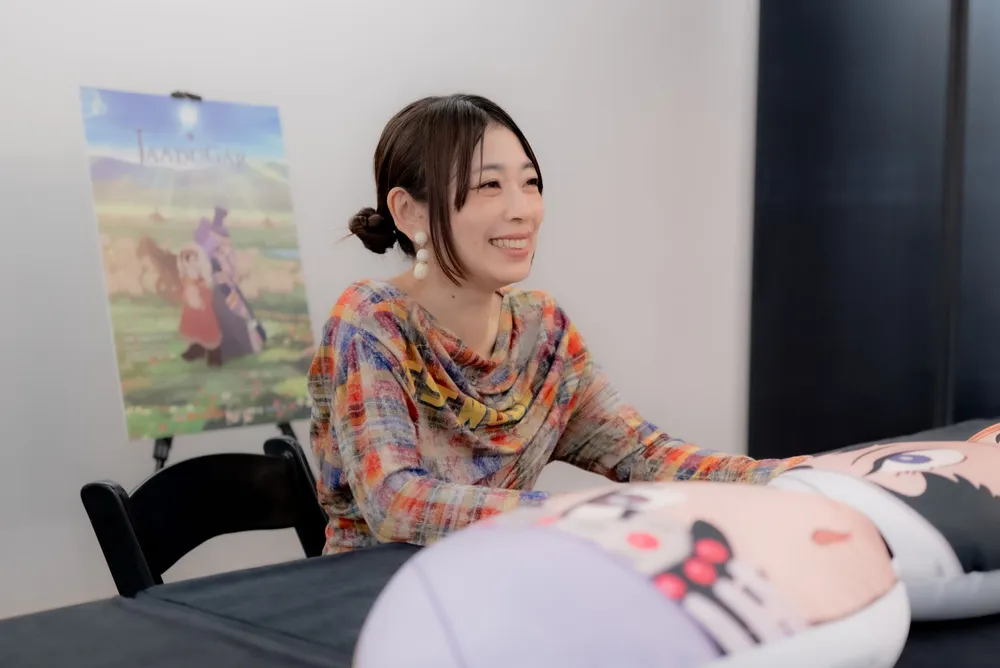
Interview: Naoko Yamada and the Strikingly Unique World of Jaadugar: A Witch in Mongolia
The Jaadugar: A Witch in Mongolia anime premiered on July 4 to very good reviews, and around this time, the Anime Atelier team interviewed the adaptation's Executive Director, Naoko Yamada. We talked about the anime's production, research process, and even got to hear from animation producer Rie Misumi and Science SARU Production Department executive Kohei Sakita.
This interview has been edited for clarity.
Q: For a story set in a historical period and culture, especially one not depicted in the anime medium, how did you approach balancing historical authenticity and emotional storytelling?
Yamada: The balance of the original work is quite interesting, as Tomato Soup-sensei crafted a story depicting real events and historical figures while also including fictional elements from her own interpretation of history. When adapting this into animation, we tried to portray this balance with care, just as the original work had done. For the historical aspects, we sought the help of experts specializing in Mongolia and Persia to bring these elements together and discuss the finer details.
Q: Yamada-san, you traveled to Mongolia for research. Though we live in a time where references and information can easily be found on the Internet, how do you think experiencing other cultures first-hand helps to develop your artistic expressions and representations of them?
Yamada: Even though we can research everything on the Internet nowadays, that kind of information is one-dimensional. Since I was actually there—well, in Mongolia, as I didn't get a chance to go to Iran—I was able to gain an understanding of the country in a three-dimensional sense, which clarified information and helped to fuel my imagination and form vivid mental images. I believe this is an incredibly important process.
Q: Were there any particularly memorable experiences during your Mongolia trip?
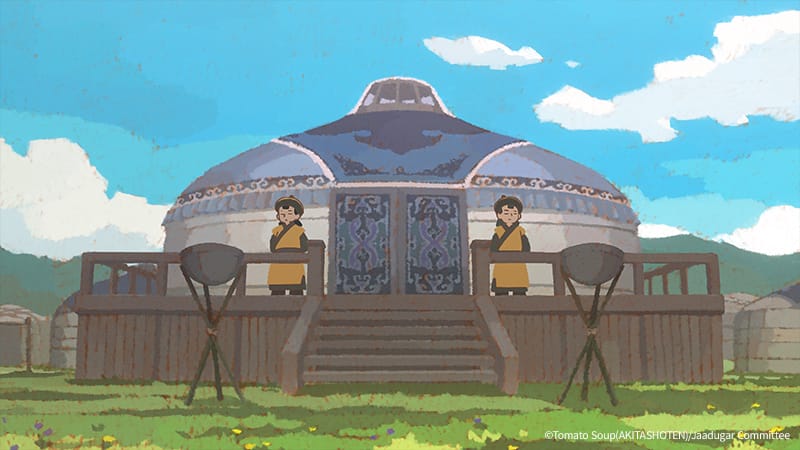
Yamada: I had the opportunity to stay with a nomadic family. In that area, there isn't any mobile network coverage, so I couldn't use my smartphone, but there was the sky, the ground, and the area itself. It's a place that only has the absolute minimum, but those are the fundamentals. I felt like many aspects of their lifestyle had been handed down unchanged from the 13th century. Witnessing how the people utilize the land and resources around them in their daily lives, while coexisting with a vast natural landscape, using only their ingenuity and wisdom, was a profound experience. I think this experience allowed us to connect more deeply with the work itself.
Q: Were there any experiences during the Mongolia trip that specifically affected any scenes that the team made?
Yamada: I visited Mongolia in spring when it was especially cold and during a time with the strongest winds of the year. The wind was so ferocious that I felt like I was almost blown away. That experience allowed me to see that fires are always being blown around by the wind and that dust is always being swept into clouds in the air, which I was able to incorporate into the work.
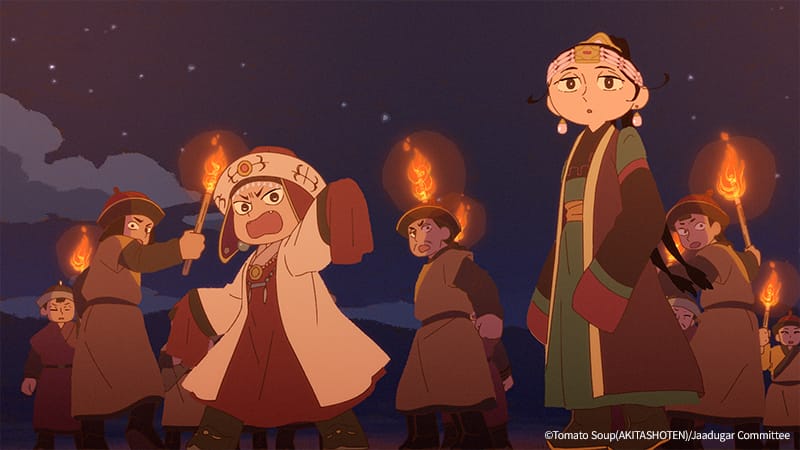
Q: Tomato Soup-sensei's manga leans into an old, manuscript-like style to emulate drawings of the Middle Ages. The character designs are simplified, and the compositions are often flattened. Were these ideas consciously developed in the anime's aesthetic?
Yamada: As we adapted this title into animation, we tried to depict more flat compositions effectively while simultaneously making the characters move around in a three-dimensional space through camera angles and fields of view.
Q: Do the staff find it more difficult to work in a style like that?
Yamada: Well... it was certainly difficult at times [smiles]. In animation, we're constantly working to create a sense of space through images using perspective, which is what we practice all the time. Creating spatial depth on a flat surface and making it appealing to look at requires a talent for design, so it's quite a challenging task.
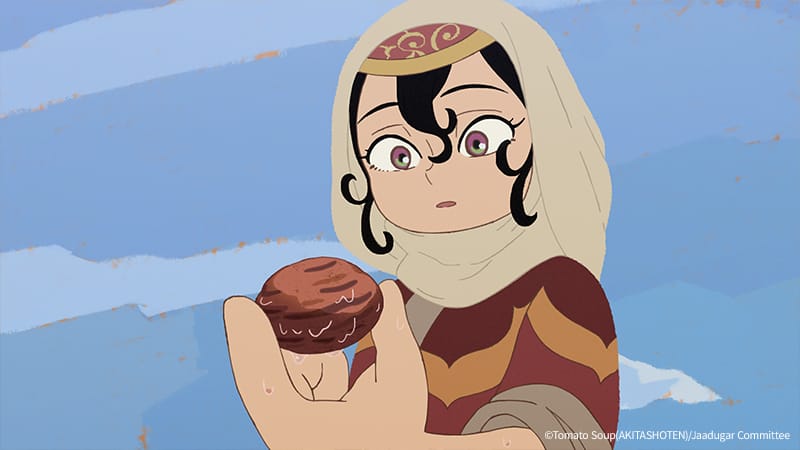
Q: The character designer is Kenichi Yoshida, but the style is different from his usual character design work. How was he chosen for the series?
Rie Misumi (Science SARU animation producer): I heard that, even before the anime project had been decided, Yoshida-san was a fan of the original work. Besides being amazed by his past works, I was impressed by his works as a character designer and animation director, in which he'd oversee the production right up to the last episode. That led us to asking him if he could join the project. This marks our [Science SARU's] first time working with him.
Q: Yamada-san, you worked in several director-level positions in the past, but this is your first time working as Executive Director. How are the duties between Yamada-san, Director Abel Góngora-san, and Assistant Director Takuya Fujikura-san being split?
Yamada: To put it simply, I stand by Abel-san's side and support him in whatever kind of animation that he wants to create [laughs]. Fujikura-san tries to organize everything Abel-san wants to do, structure it, and articulate it.
Q: How did you get involved with the series?
Yamada: I'm basically here to lend my support. I joined the team because I heard Abel-san was going to be the director for this project. As I'm a director [kantoku, 監督] myself, I rarely get a chance to see other directors' work up close. I personally like Abel-san's work, so I wanted to learn from him. That's why I got involved, to help out however I could.
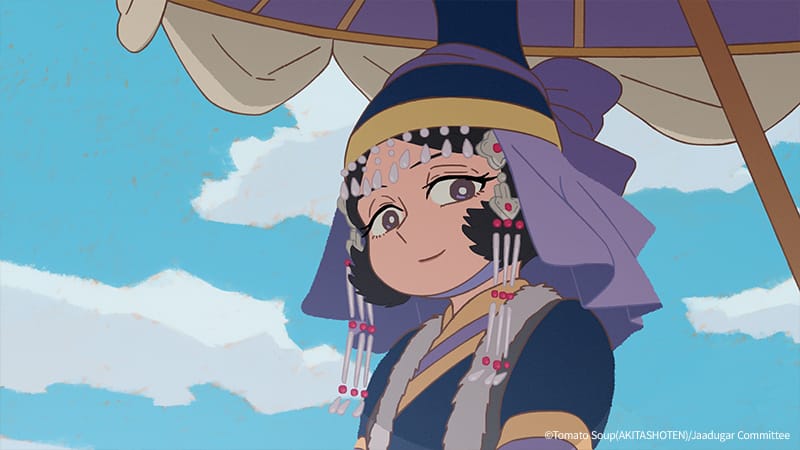
Q: To my understanding, this is Misumi-san's first work as animation producer at Science SARU. How was she chosen for the series?
Kohei Sakita (Science SARU Production Department executive): Misumi had worked with Yamada-san on another project, The Colors Within, and when we were thinking about her next project, taking into account that Abel-san was going to be the director and the production situation on other projects, Misumi was considered as the best fit for this project. The fact that she had served as the setting design manager for Inu-Oh, which is set in the Muromachi period and was a project that required a deep understanding of the historical facts, the era, and the setting, would also allow her to leverage her experience on this equally demanding project.
[Note: Misumi was assistant producer for The Colors Within.]
Q: The music is being composed by Koshiro Hino from the experimental band Goat (JP). How was he selected for the series?
Yamada: He makes avant-garde electronic music, and I was familiar with a film he did, Shiver, that uses taiko drums. I was interested in the prospects of fusing with his musical style and the instruments that he uses, and he has a unique sense of rhythm. I couldn't imagine what the result would be, but that made it interesting, so I asked him to work on this project, anticipating what kind of music he'd make.
[Note: The movie Yamada is referring to is Shiver (2021), directed by Toshiaki Toyoda.]
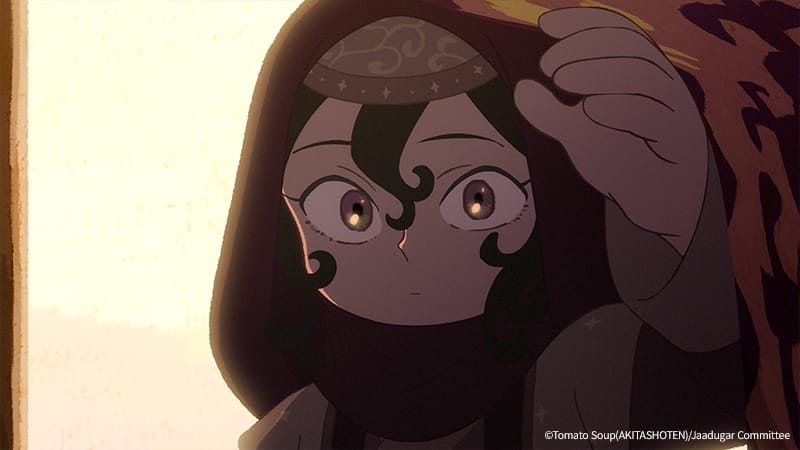
Q: Aside from the cultural aspects, what do you think makes Sitara and Fatima unique characters in today's anime scene?
Yamada: I think it's hard to understand them. They have a mix of traits. There is an aspect of purity and honesty within them, but at the same time, they have this... stubborn side [laughs]. They have two sides, especially Sitara, and that's rare for anime characters. Sometimes, she's quite mysterious because we don't know if she's telling the truth or not. What she's thinking and what she's saying are sometimes quite different. She's quite unpredictable, and that makes her unique.
Q: What has been your favorite part about working on this series?
Yamada: Hmm... well... there's a lot...
Q: It can be the first one that comes to mind.
Yamada: I've been a huge fan of Kenichi Yoshida-san, the character designer, and I never imagined I'd get to work with him. As we started working, I've been able to see his drawings, which are absolutely incredible. It brings me a lot of joy to see his art with my own eyes. This is a project that lets me savor the joy of creating animation all over again, and I'm really enjoying that.
We'd like to thank Yamada-san and the Science SARU team for taking the time to answer our questions and share their vision of the Jaadugar: A Witch in Mongolia world with us!
You can catch new episodes of the Jaadugar: A Witch in Mongolia anime weekly on Crunchyroll.
Interviewer: Sarca
Interpreter: Tomo Tran
Assistance: Carla Bianca Carreon
Editor: Tamara Lazic