
Review: Crescent Moon Marching Volume 1
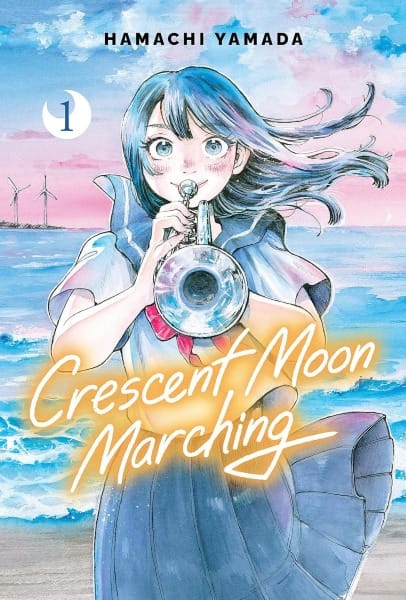
Readers may recognise Crescent Moon Marching from when Omoi (formally Azuki) licensed the series for a digital release through their platform back in 2023. Now this series is making the jump to print and eBook in new full-color editions from Scholastic under their Graphix imprint. Aimed at a preteen audience, how does this series fare? Let’s take a closer look!
The Premise
Our story follows 16-year-old Mizuki, a high school student struggling with the pressure put upon her by her parents and surroundings. One day she decides she’s had enough and runs away from Tokyo to Akita, where her aunt lives and runs a small café. Mizuki spent the summer here when she was much younger, and her aunt reassured her that she was always welcome, so this seems like the perfect solution for our young heroine.
Outside of studying, Mizuki has no real direction or interests. She wants to do something different for Spring Break, but when questioned as to what, she can only draw a blank. That changes when she meets Akira, a somewhat grumpy student who works at the café and plays the trumpet in his school’s marching band. Mizuki ends up getting to see the band perform while out on deliveries with her aunt. And this experience completely floors her. It’s like nothing she’s ever seen before and she’s inspired to give it a go herself…
Right Place, Right Time
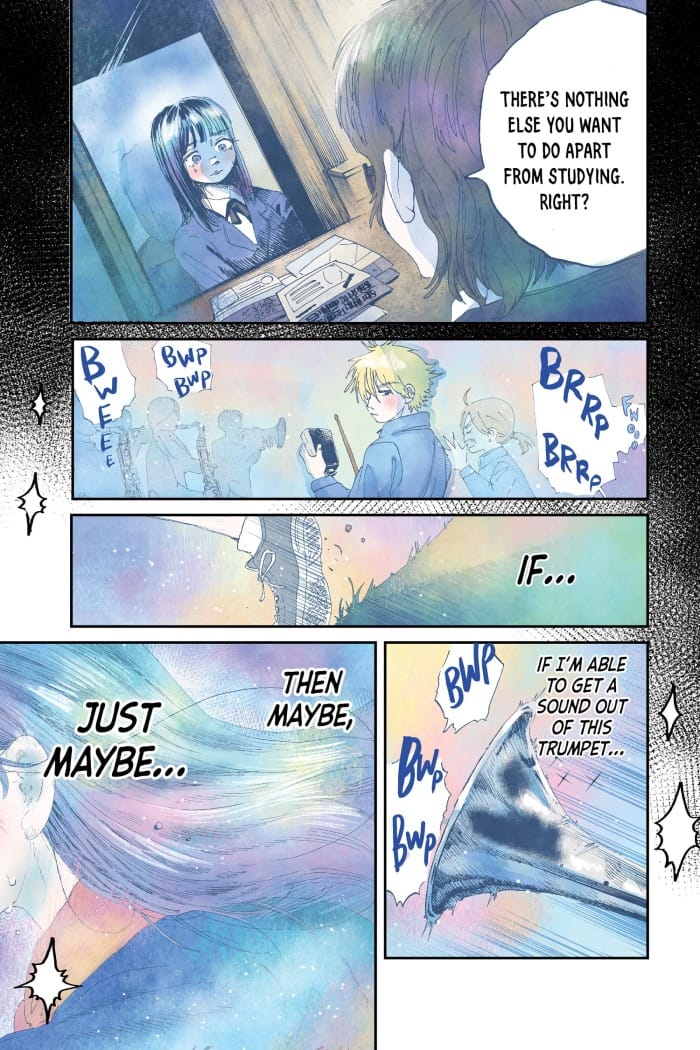
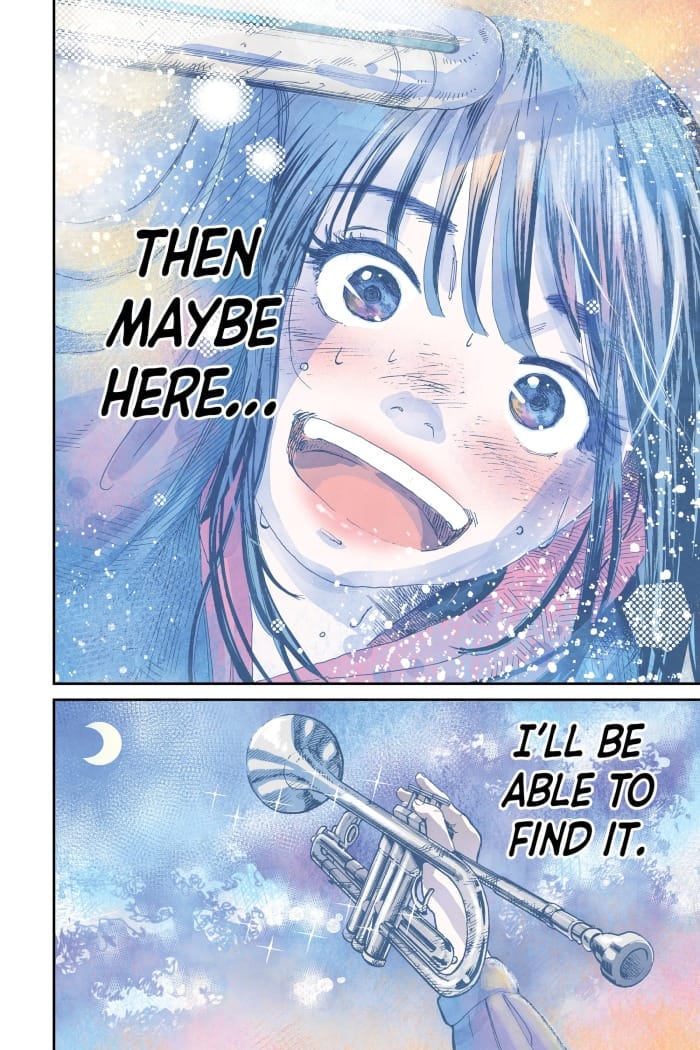
I’m sure many of us can relate to Mizuki’s experience of being unsure of where she’s going in life and what she even cares about. Sometimes a change of scenery and encountering something new at the right time can change your life for the better. And don’t get me wrong, there’s no overnight fix for Mizuki, but she does at least have a goal to work toward now.
Wishing to join the marching band for herself, Mizuki tells her parents she wants to transfer to this school in Akita. Her parents aren’t thrilled, but they give in and let her stay for now. Mizuki starts learning the trumpet alongside Akira and begins preparing for the upcoming marching contest, but with so much to learn and no prior experience, it’s a difficult road to travel.
Inspired But Flawed
What struck me most while reading Crescent Moon Marching is that this is a very inspiring story, but it almost never takes the time to slow down. From Mizuki’s arrival in Akita through to the start of the contest, all of this happens in just five chapters. It means that readers don’t get the chance to truly get to know any of the extended cast or a great deal about what being in a marching band entails (outside of some basics). This especially hurts Akira’s character because he’s often quite gruff with Mizuki, and maybe there’s a reason for that in his past (was he once lost like her?), but we just don’t get to spend enough time exploring his character, so he ends up being unlikable as a result.
This is a shame because I think mangaka Hamachi Yamada has a great core message here, particularly for younger readers or those of a similar age to Mizuki. Yamada has won an award for her one-shot Aitsu wa Sorairo no Kuruma de, but this is her debut series, and perhaps that’s why there are so many pacing issues. There are plenty of good ideas here, so hopefully as it continues on, Yamada will get a better grasp of what’s necessary to polish it into the engrossing work it’s boarding on being.
Graphix Release
As mentioned, Crescent Moon Marching was previously released on Omoi, but for print and eBook it’s Scholastic taking charge and putting it out under the Graphix imprint. Notably, the series has also made the jump into full color for these releases through a deal Scholastic made with Japanese company Culture Weaver, who worked on colour versions of Hikaru in the Light! And Mecha-Ude: Mechanical Arms under the same deal. Together, they worked with Indonesian art studio KOSMIK to create these editions. It has retained the Omoi translation by Arthur Miura with lettering by Barri Shrager, which reads well.
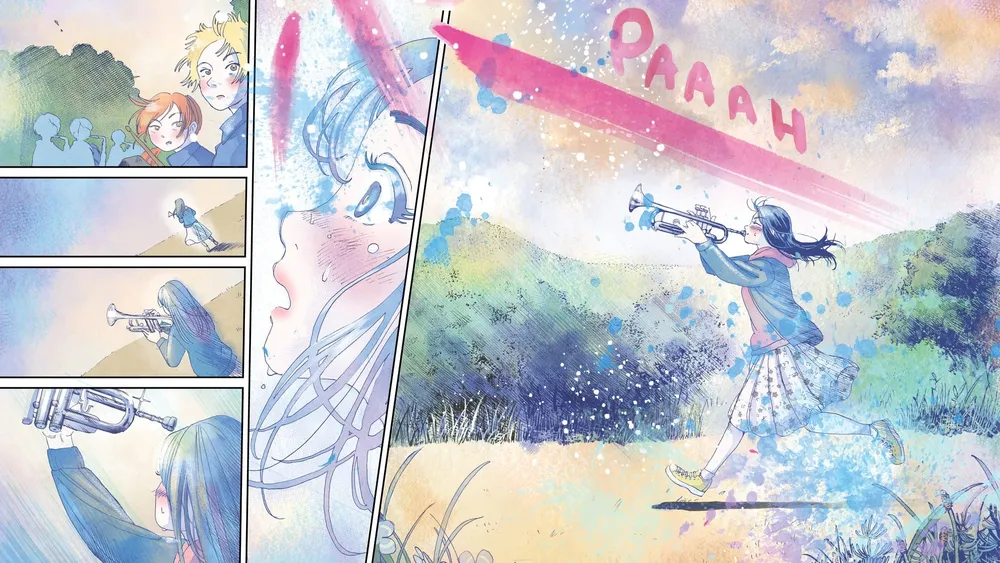
The original release of Crescent Moon Marching had some color pages, and I think Culture Weaver and KOSMIK have done an excellent job of capturing the style and color palette of the Yamada’s original work. However, in the transition, I think we lose some of the charm of the black and white art. The art we have here is quite muted and uses pastelly shades, which doesn’t always work when there are darker scenes (such as those set at night). I find if there’s a lot going on, scenes become muddy and hard to unpack. Having read the original version on Omoi, I can’t help but feel that is a better way to experience it, and it’s a shame that there isn’t an optional version going into print for those who want that.
The series is complete in Japan with 8 volumes, all of which are available to read through the Omoi service. Graphix has volume 1 coming out in English in paperback, hardcover and eBook editions, which offers readers plenty of choice for how they wish to collect it. Volume 2 is currently scheduled for an English release in November, but nothing further is currently pencilled in.
In Closing
This is mixed release from Graphix. The added color ends up taking away from the original work, which itself is flawed through pacing issues. However, I think the core themes will still resonate with readers, so it is worth picking up if you find yourself intrigued by the premise.
More details are available on the Scholastic website. Our review copy was supplied by the publisher.
©Hamachi Yamada / Futabasha Publishers Ltd. / Scholastic